Planning a gentle goodbye for your horse
In a large RSPCA survey, 75.4%[1] of owners grieved before their pet died. A planned farewell gives that feeling somewhere to go, and makes the day itself calmer.
- Who, where, and what you'd like to happen
- Tips for fitting around the vet and truck
- A printable checklist for the day
Farewell & memorial service planner
A goodbye doesn't need to be big to mean a lot. Choose what feels right and we'll turn it into a simple checklist you can print or copy.
Your plan
A farewell for our pet
At home
Next step: Arrange cremation or a service near you →
Why plan it
Why a planned farewell helps horse owners
Many horse goodbyes can be planned, because euthanasia is often chosen for an older or chronically ill horse rather than forced by an emergency. That gives you something precious: the chance to decide how the last day goes, who's there, and what you'll want to remember.
Planning also protects the day from logistics. A horse's aftercare has hard edges, like a truck that needs firm ground or a state rule that gives you only 24-72 hours[2] to deal with the body, as Cornell's horse disposal fact sheet notes. Sorting those out in advance means the farewell itself can be slow and quiet.
Using the planner
Four questions the planner walks you through
- Who. Close family, children, friends and neighbors (riders, the barn manager and a longtime farrier fit here), other animals such as the horse's companions, your vet or care team, or a celebrant.
- Where. The choices are broad: "at home" covers your own paddock, barn aisle or a quiet corner near the gate, and "a favorite walk or place" covers a field or trail elsewhere. There are also a pet cemetery, the crematorium and an online option.
- Rituals. A candle, a reading or poem, a letter, a photo display, shared memories, a tree to plant, or scattering ashes later. A last feed, a grooming or a braided tail aren't on the list, so note those yourself.
- Music. A song on a phone, or simply the sounds of the barn.
As you choose, the planner builds a checklist you can tick, print or copy. There's no notes box, so once you've copied it, add lines such as who will hold the lead rope and who will call the provider afterwards.
Keep it small if that suits you. Some of the most meaningful goodbyes involve two people, a bucket of feed and a quiet hour in the field. Others bring the whole barn together. The planner doesn't favor either; it just makes sure the details you care about are written down before the day arrives.
The practical side
Fitting the farewell around the vet and the truck
Choose the goodbye spot with the vet and the collection vehicle in mind. A level, firm area a truck can reach is kinder than a place that means dragging or a long winch. If your horse's favorite field is far away, you might spend the morning there and hold the final moments nearer the barn. Our guide to planning your horse's euthanasia day covers the timing, the spot and who does what.
Book the vet and the provider together. Some owners prefer collection an hour or two after euthanasia, to allow time with the body; others prefer the truck soon after, before the day gets any longer. Tell both what you'd like. The ashes won't come back the same day either: by our estimate a 1,100 lb horse needs at least 4.4 hours[3] of burn time alone, before cooling. Our article on working with your vet on end-of-life care covers the timing conversation, and our farm access guide covers the truck.
An example
Worked example: a Saturday goodbye for a 32-year-old pony
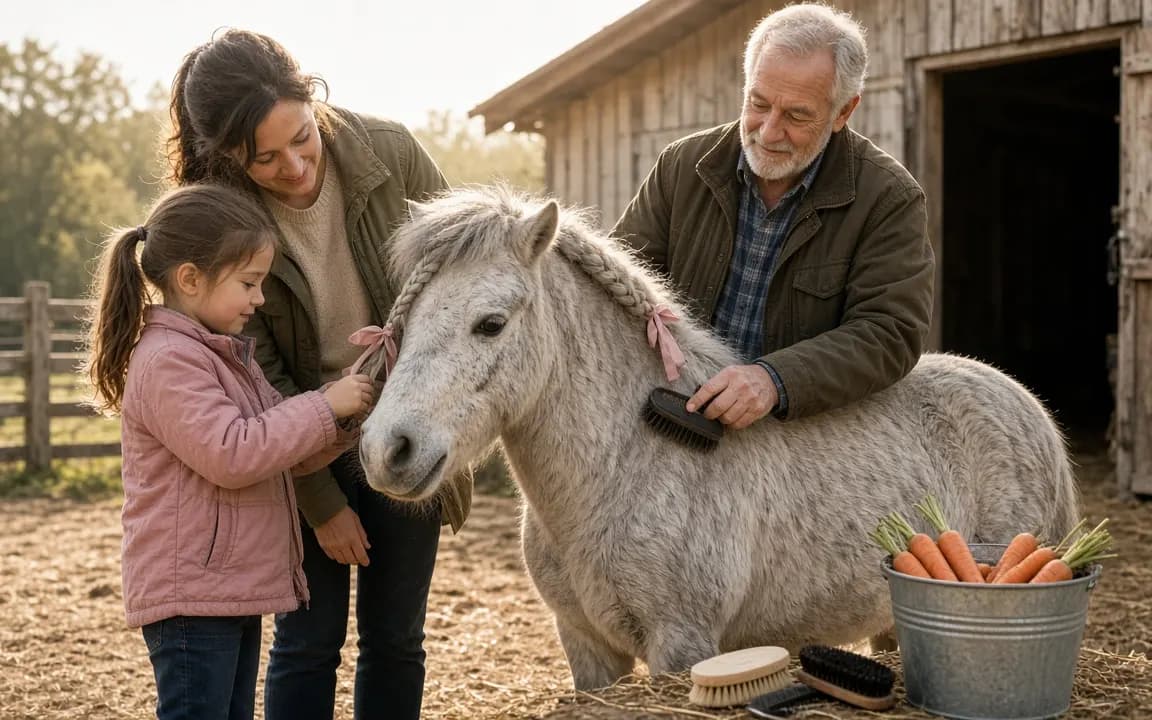
A family plans a goodbye for their 32-year-old Connemara pony. The grandchildren come in the morning to brush him and plait ribbons into his mane. Everyone shares carrots and his favorite mints. His tail is braided and cut from underneath, one braid for each child.
At noon, he's led to the flat grass by the gate, where the vet's truck and the collection vehicle can both reach. The children say goodbye first and walk back to the house with a grandparent. The owner stays for the euthanasia. Collection is booked for 2 pm, giving the family time with him and a chance for his field-mate to see him.
Where would you want your horse's last moments to be?
Tap an answer to vote and see how others answered. Anonymous.
Special care
Including children and companion horses
Parents often don't know how much to involve children. In the RSPCA's pet-loss survey, 93.4%[4] of parents wanted better guidance on helping children through pet loss. A simple approach works for many families: let children help with the grooming and goodbye, then leave before the vet begins, and tell them honestly and simply what happened.
Companion horses matter too. With 55%[5] of US horse-owning households keeping two or more horses, many goodbyes leave a field-mate behind. Letting the companion see and sniff the body for a few minutes may help it settle. Watch it closely for a few days afterwards, and don't leave it completely alone.
Next steps
What the planner can't do, and what comes after
It can't choose the day for you, and it can't make the moment painless. Only you and your vet can decide when it's time; the AAEP's equine euthanasia guidelines describe what vets weigh. What it can do is make sure the things you'd regret forgetting, like the tail braid, the photo, or the call to a friend, are written down.
After the farewell, the aftercare begins. Our services page explains the options, the memorial budget planner adds up the costs, and the grief check-in is there for the weeks that follow. If you'd like a provider lined up before the day, tell us about your horse.

Free tool
Memorial budget planner
Add up cremation, urn, keepsakes and a farewell so the total holds no surprises.

Reader polls
What would you choose?
Vote anonymously and see how other readers answered. The results are live counts from people who visit this site, so they show real opinions, not a scientific sample.
Where would you want your horse's last moments to be?
Tap an answer to vote and see how others answered. Anonymous.
What would you most want to keep from your horse?
Tap an answer to vote and see how others answered. Anonymous.
Where would you prefer your pet's final moments to happen?
Tap an answer to vote and see how others answered. Anonymous.

Free tools to help you plan
Farewell & memorial service planner
Build a simple goodbye: who, where, readings, rituals and a checklist.
Memorial budget planner
Add up cremation, urn, keepsakes and a farewell so the total holds no surprises.

Pet loss grief check-in
A private, two-minute check-in on how you're coping, with ideas that match where you are.
Questions people ask
Where is the kindest place for a horse to be euthanized?
Somewhere calm and familiar, on firm, level ground that a collection truck or machine can reach afterwards. Many owners choose a paddock near the gate or the grass outside the barn. Your vet can advise on footing, space for the horse to go down safely, and access.
Should I stay with my horse during euthanasia?
It's entirely your choice. Many owners find comfort in being there, and horses often settle with a familiar person at their head. Others find it too hard, and that's okay too; your vet will take care of your horse. If you stay, ask the vet beforehand what you'll see.
Can I give my horse treats on the last day?
Usually yes, and many owners do. Check with your vet first, because some conditions, like colic or choke, make feeding unwise. If it's allowed, a favorite feed, apples, carrots or peppermints make a gentle last memory for you and a good day for your horse.
How do I explain my horse's death to young children?
Use simple, honest words, such as saying the horse died and won't come back, rather than phrases like went to sleep, which can confuse or frighten. Let them ask questions, share their own memories and keep something, like a braid of tail hair. Many children find a small ritual helps.


Sources and our estimates
- [1] 75.4% of RSPCA pet-loss survey respondents experienced anticipatory grief before their pet died. RSPCA — Pet Loss Survey Results, 2026.
- [2] State rules commonly require dead animals to be buried within 24 to 72 hours of death, especially when euthanized. Cornell Waste Management Institute & Penn State - Horse Mortality: Carcass Disposal Alternatives (2012), 2012.
- [3] At an average rate of 250 lb per hour, the burn phase for a 1,100 lb horse would take at least about 4.4 hours, not counting preheating and cool-down. Our estimate: 1,100 lb / 250 lb per hour. How we calculate.
- [4] 93.4% of parents in the RSPCA survey wanted better guidance on helping children through pet loss. RSPCA — Pet Loss Survey Results, 2026.
- [5] 55% of US horse-owning households have two or more horses. American Pet Products Association (APPA) 2025 National Pet Owners Survey release, 2025.
Line up aftercare before the day
Tell us what you need and where you are. We'll reply by email with clear options and prices so you can decide in your own time.