Getting a truck to your horse: farm access, gates and ground
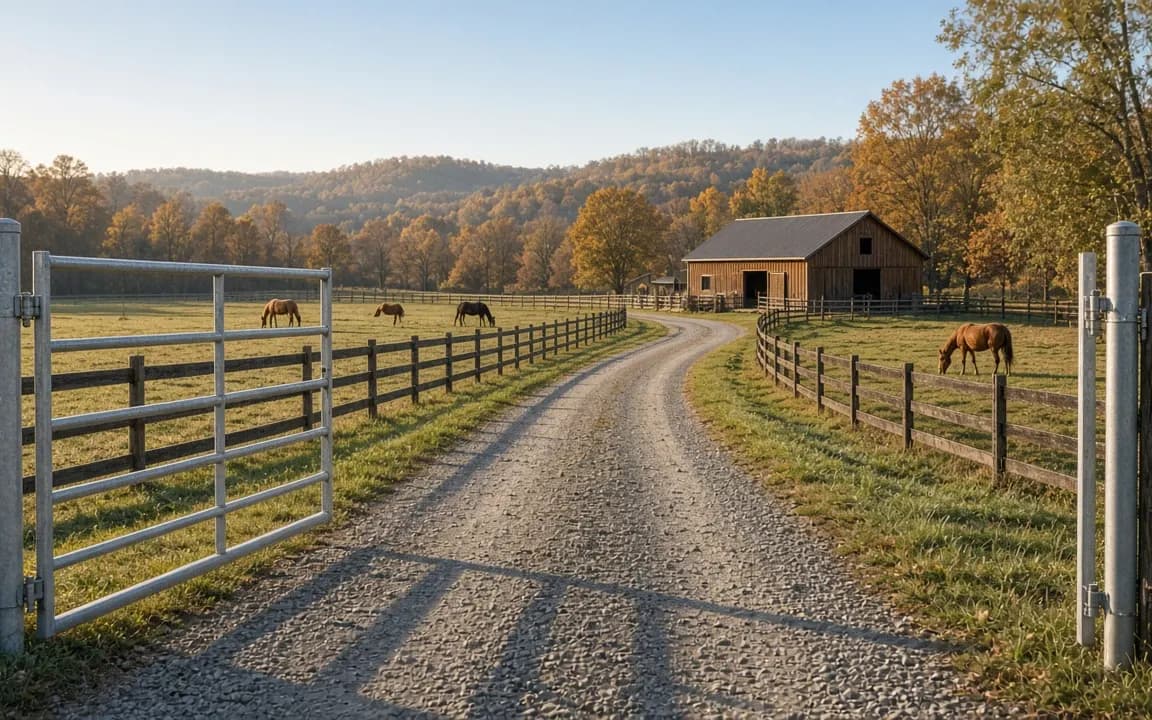
A collection truck needs a firm, fairly level route to within a short winch-cable length of your horse. If you can choose the spot in advance, pick hard standing near a wide gate, and describe the route to the driver before they leave.
By the Equine Cremation Services editorial team · Updated September 24, 2026 · 5 min read · Sources
- Picking the right spot for a planned goodbye
- What a winch truck needs on your land
- Plans for mud, snow and steep ground
The short answer
Why does farm access matter so much for horse aftercare?
Because once a horse has died, it can't be moved by hand. Whoever collects, whether a crematory, a renderer or a burial crew, needs to bring a vehicle close enough to winch or lift about half a ton. If the truck can't reach, you may need a tractor with a loader or a second trip, both of which add time and money on an already difficult day.
Most of this can be solved in advance. Around 2 million[1] US households own horses, and many keep them on land that was never designed for heavy trucks. A walk around your property with one question in mind, "could a truck get here in February?", tells you most of what you need to know.
For a planned goodbye
Where should a planned euthanasia take place?
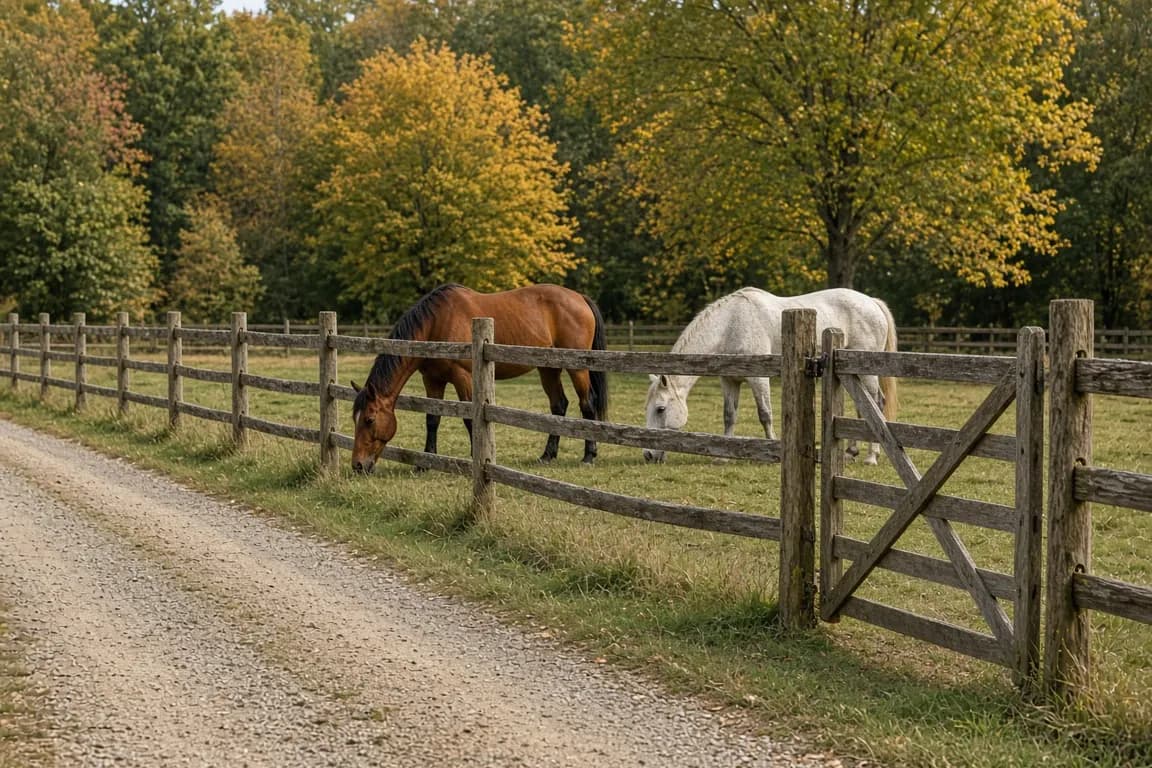
The kindest place for your horse and the practical place for the truck are often the same: a quiet, familiar patch of level ground next to a hard surface. A grass verge beside the driveway, the edge of an arena, or a paddock corner by the gate all work well. Your horse can graze, and the driver can back up without churning the field.
- Avoid stalls and aisles if you can. Removing a horse from a stall is possible but awkward, and many owners find it hard to use the stall afterwards.
- Avoid slopes. A horse going down on a hill can slide, and a truck parked on a slope is harder to winch against.
- Think about sightlines. Choose somewhere the neighbors and road traffic can't easily see, and where other horses can be kept at a distance.
- Check overhead. Power lines and low branches get in the way of tilt-beds and lifting arms.
Talk it through with your vet, who will also want safe footing for themselves. Our article on planning the day with your vet covers the rest of that conversation.
The vehicle
What does a horse collection truck need from your property?
| Vehicle | How it loads | What it needs |
|---|---|---|
| Box truck or enclosed trailer with winch | Cable pulls the horse up a ramp on a slide sheet | Straight approach, firm ground, often within about 50 to 100 ft |
| Tilt-bed or roll-back | Bed tilts down; winch pulls the horse on | Room to tilt, level ground, no low wires |
| Pickup with livestock trailer | Usually needs a loader or several helpers | Tractor access; not ideal for heavy horses |
| Tractor with front loader (yours or a neighbor's) | Moves the horse to hard standing for pickup | Straps and a skilled operator |
Ask the provider which vehicle they'll send and how long their winch cable is. Then measure the gate and walk the route. Write down the narrowest point, any tight turns, cattle grids, soft patches and the distance from the nearest hard surface to where your horse will be.
Mud, snow and heat
What if the ground is too soft or frozen for a truck?
Wet clay and thawing ground are the most common problems. A heavy truck can sink even where a car drives easily. If the ground is soft, the usual answer is to move the horse to hard standing with a tractor, or to lay heavy boards or track mats. Ask the provider what they carry; some have mats, some don't.
Frozen ground is often easier for a truck, but it rules out burial for months in cold states, which is one reason winter deaths push many owners toward cremation or rendering. The services page and our article on burying a horse on your property explain the depth and setback rules if you're weighing it up.
Heat is the other pressure. A large body warms quickly in summer, and, as Cornell's horse disposal fact sheet notes, states often expect a decision within 24-72 hours[2]. Pennsylvania's mortality disposal rules, for example, require disposal within 48 hours[3]. That doesn't mean rushing into a choice you'll regret, but it does mean making the call to a provider early in the day.
Where does your horse live?
Tap an answer to vote and see how others answered. Anonymous.
Not your land
How does collection work at a boarding barn or showground?
At a boarding barn, the owner of the land controls the gate, the tractor and the timing. Ask the barn manager now where they would want a horse to be euthanized, whether their loader can be used, and which collectors they've worked with. Some barns prefer one company because it knows their layout. You can still choose your own; just make sure both sides know.
Showgrounds, trail heads and clinics are harder. If your horse dies away from home, the venue's vet will usually coordinate, but you may have less choice of provider. It helps to carry your aftercare wishes on your phone, as covered in our pre-planning article.
When the driver arrives
What should you do when the collection vehicle arrives?
- Have someone meet the driver at the road gate and walk them in.
- Move other horses, dogs and children well away from the route.
- Confirm the paperwork and the ID tag number before loading starts. The certificate guide explains why.
- Make sure you've taken any tail hair, the halter and a shoe if you want them.
- Decide whether you want to watch the loading. Many owners say goodbye first and step away; that's completely normal.
Loading usually takes a few minutes once the truck is in place. Drivers do this every week and will cover your horse and handle them carefully. If you'd like to understand the rest of the journey, read our transport and logistics article.
Five minutes with a tape measure at the gate now can spare you an hour of waiting beside your horse later.
What access does to the price
Does difficult access cost more?
Often it does. Extra time, a second person, a tractor hire or a failed first attempt can all add charges on top of the collection fee. Rendering pickups are commonly quoted at $75-$200[4], while private cremation of a 1,000 lb horse has been reported at $600-$1,000[5] before transport, so an access surcharge can be a big share of a small bill. By our estimate, cremation already works out at about $0.80/lb[6] of body weight, so a costly collection on top can tip some owners toward a closer option.
The horse aftercare cost comparison gives ranges for each option by weight. Describe your access honestly when you send us your details, and we'll ask providers to include it in their quotes.

Free tool
Horse aftercare cost comparison
Compare equine cremation, burial, rendering and composting side by side.

Reader polls
What would you choose?
Vote anonymously and see how other readers answered. The results are live counts from people who visit this site, so they show real opinions, not a scientific sample.
Where does your horse live?
Tap an answer to vote and see how others answered. Anonymous.
Where would you want your horse's last moments to be?
Tap an answer to vote and see how others answered. Anonymous.
Where would you prefer your pet's final moments to happen?
Tap an answer to vote and see how others answered. Anonymous.


Questions people ask
How close does a truck need to get to a dead horse?
It depends on the vehicle and its winch cable, but many collectors want to be within roughly 50 to 100 feet on firm ground with a straight pull. Ask the provider for their limit. If they can't get close enough, a tractor with a loader can usually move your horse to hard standing first.
Can a horse be removed from a stall?
Yes, usually by winching through the stall door and down the aisle, but it's slower and harder than collecting from open ground, and narrow doors or tight turns can make it impossible without a loader. If euthanasia is planned, walking your horse to a quiet spot outside is easier for everyone.
What if my horse dies in a field the truck can't reach?
Tell the provider straight away and describe the ground. Common solutions are a tractor with straps or a front loader to bring your horse to a lane, or track mats laid over soft ground. Some collectors can arrange a local operator; others will expect you to find one, so ask.
Should other horses see the body?
Many owners let a close companion sniff and stand with the body for a few minutes, and some find the companion settles more quickly afterwards. Keep it calm and short, then move the other horses away before the truck arrives, as vehicles and winching can unsettle them.
Do I need to be there when my horse is collected?
Not necessarily. Many collectors will pick up if a barn manager, friend or vet is present to meet them and sign the paperwork. Arrange it in advance, send access photos and a map pin, and ask the provider to call you once your horse is loaded.


Sources and our estimates
- [1] About 2 million US households own horses. American Pet Products Association (APPA) 2025 National Pet Owners Survey release, 2025.
- [2] State rules commonly require dead animals to be buried within 24 to 72 hours of death, especially when euthanized. Cornell Waste Management Institute & Penn State - Horse Mortality: Carcass Disposal Alternatives (2012), 2012.
- [3] Pennsylvania requires a dead domestic animal to be properly disposed of within 48 hours of death. Penn State Extension - Livestock and Poultry Mortality Disposal in Pennsylvania (J. Craig Williams, updated Oct 2025), 2025.
- [4] Rendering companies typically charge a pickup fee of $75-$200 to remove a horse carcass, depending on location. Extension Horses (eXtension national Cooperative Extension) - Horse Disposal Options, 2019, 2019.
- [5] Cremating a 1,000-pound horse was reported to cost about $600-$1,000, depending on location and the price of propane. Extension Horses (eXtension national Cooperative Extension) - Horse Disposal Options, 2019, 2019.
- [6] Midpoint horse cremation cost works out to about $0.80 per pound of body weight, versus about $0.14 per pound for rendering pickup and $0.23 per pound for on-farm composting. Our estimate: cremation $800 / 1,000 lb; rendering $137.50 / 1,000 lb; composting $275 / 1,200 lb. How we calculate.
Get horse collection options for your farm
Tell us what you need and where you are. We'll reply by email with clear options and prices so you can decide in your own time.