Sharing your horse's ashes with everyone who loved them
A full-size horse returns roughly 38.5 lb[1] of ashes on our estimate, enough for many keepsakes. Plan who gets what, and what stays in the main urn.
- Keepsake urns, pendants, rings and scattering
- An allocation table, person by person
- What remains for the main urn
Ashes sharing planner
Plan who keeps what. We work in cubic inches, the unit urns and keepsakes are sold in (about 1 cu in per lb of body weight).
Left for the main urn
1,097 cu in (17,976 mL)
Out of about 1,100 cu in in total.
| Person | Keepsake | Ashes |
|---|---|---|
| Me | Keepsake urn | 3 cu in |
| Person 2 | Pendant | 0.05 cu in |
| Main urn | 1,097 cu in | |
A pendant holds about a pinch of ashes and a ring even less, so jewelry barely changes what's left. Scattering tubes vary a lot in size; check the one you choose.
Source: Embrace Pet Insurance - Bury or Cremate Your Dog? Costs, Pros & Cons; Our estimate. keepsake capacities are typical sizes, so check the product you choose
Next step: Ask a local provider to divide the ashes for you →
Using the planner
Building your sharing plan, person by person
Start with the total. You can enter your horse's weight and let the planner estimate the ashes, or type in the amount the crematory tells you it will return. Then add each person and choose what they'd like: a keepsake urn, a pendant, a ring, or a scattering tube. The allocation table fills in, with the remainder shown at the bottom.
- Keepsake urn: about 3 cubic inches each, a small handful.
- Pendant: about 0.05 cubic inches, a pinch.
- Ring: about 0.02 cubic inches, a few grains.
- Small scattering tube: about 10 cubic inches, for someone who wants to scatter in a place of their own.
Talk to the people you're adding before you finalize anything. Some will want a share straight away; others may prefer to wait, or would rather have a tail braid than ashes. The planner is easy to change, so rough it out first and firm it up once everyone has had time to think.
The method
How the planner does the arithmetic
When you enter weight, the planner converts it to volume using the rule of one cubic inch of ash space per pound of body weight, the same rule behind our cat and dog urn estimate (12 cu in (cat); 70 cu in (dog)[3]). Ash is mostly bone, and a peer-reviewed study of 100 cremations found frame size predicted the amount better than body weight, so treat the total as a guide. It then subtracts each person's share, using the typical capacities above, and shows what's left.
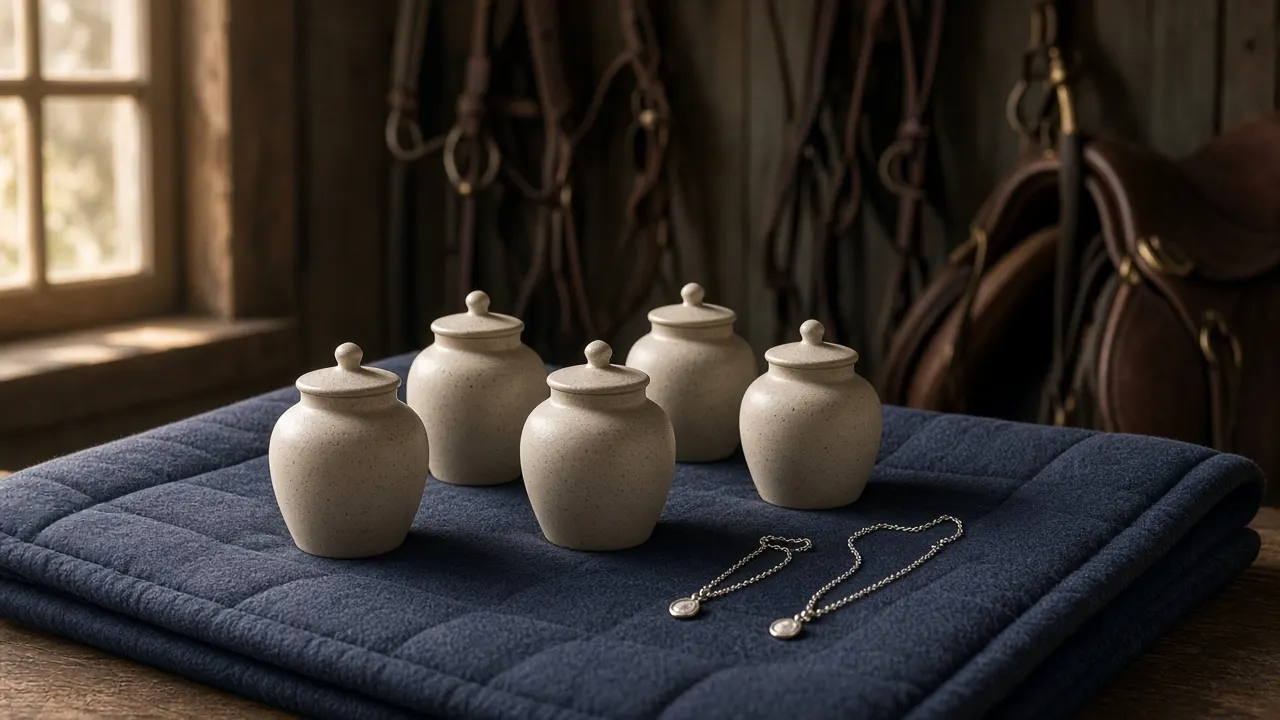
Jewelry takes almost nothing. You could fill a hundred pendants from a horse and barely notice the difference in the main urn. Keepsake urns and scattering tubes are what actually use up volume, so those are the choices to think about. One industry report puts personalized urns at about USD 50–1,000+[4], so the cost adds up faster than the ashes run out.
An example
Worked example: one Morgan, seven people
A 1,000 lb Morgan gelding gives about 1,000 cubic inches to work with. His owner wants the main urn. Her two children each want a keepsake urn and a pendant. His lease rider wants a keepsake urn. The barn manager and the farrier each want a pendant. And his first owner, who bred him, asks for a scattering tube for the farm where he was born.
That fits the planner's eight rows exactly: the owner needs no row, because the main urn is what's left. Three keepsake urns take about 9 cubic inches, four pendants a fraction of one and the small scattering tube 10. About 981 cubic inches remain, far more than one urn at home needs. The owner decides to keep a large urn and scatter the rest along the ridge where they used to ride.
Reading the plan
What to do with what's left over
For most horses, the remainder is the biggest decision. Scattering over a favorite field, burying under a tree, or keeping a large urn or chest are all common. The urn size calculator sizes containers for whatever you keep, and the farewell planner helps if you'd like a small gathering when you scatter.
Free tool
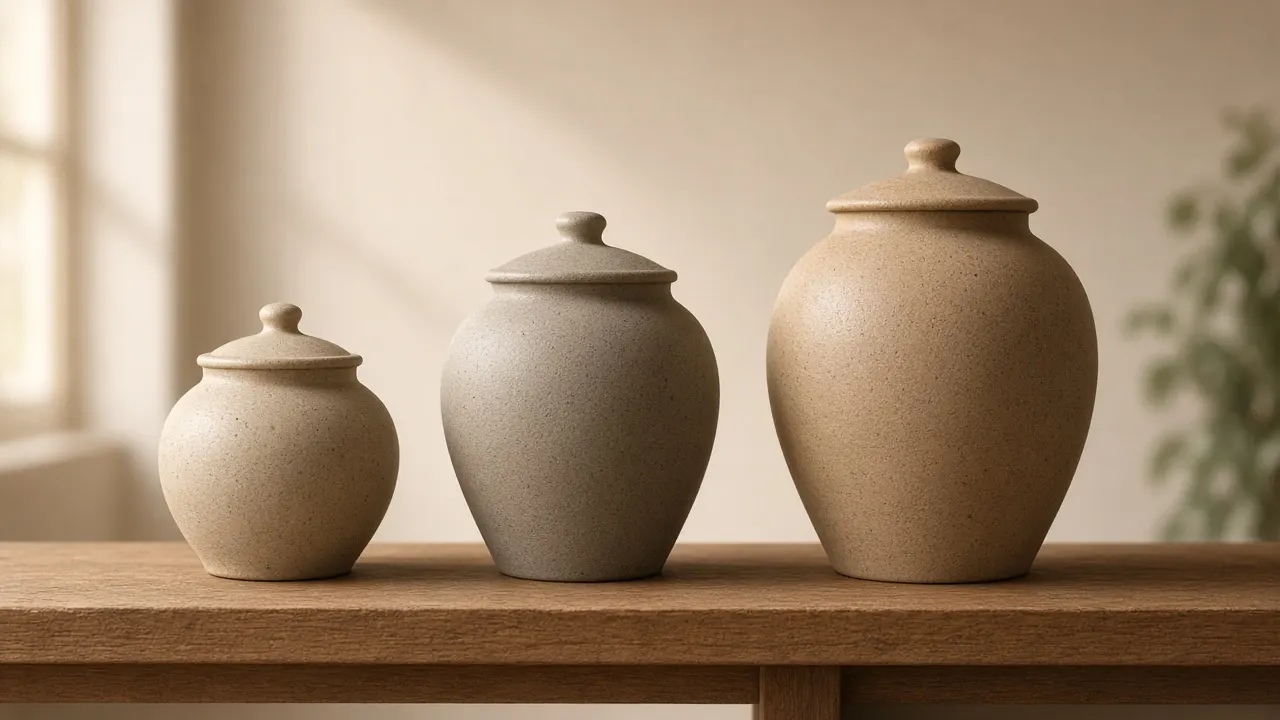
Urn size calculator
Find the urn volume you need from your pet's weight, plus keepsake and sharing options.
If your horse's ashes came home, what would you do with them?
Tap an answer to vote and see how others answered. Anonymous.
Being honest
Things the planner can't settle for you
It can't tell you whether your crematory returns all of the ashes. For large animals, some return a set portion, so confirm the amount before promising shares. It's also fair to ask whether the operator holds a CANA pet crematory operator certification, which covers handling and identification. It also can't settle disagreements. If a horse was co-owned, agree on the plan in writing before cremation; our guide to documentation after equine cremation explains who can sign.
Some of the most cherished keepsakes aren't ashes at all. A braid of tail hair for each person costs nothing and can be made into a bracelet or framed. It has to be cut before collection, so read our mane and tail memorials guide early.
What to do next
Next steps for a fair, calm share
Ask everyone what they'd like before the ashes come home, so no one feels left out. Confirm the returned amount with the provider, order keepsakes to fit, and divide the ashes on a calm, dry day with a small scoop and a funnel. Our article on urn sizing and selection for horses has container ideas, and the services page explains what private cremation includes. Need a provider first? Send us your details.

Reader polls
What would you choose?
Vote anonymously and see how other readers answered. The results are live counts from people who visit this site, so they show real opinions, not a scientific sample.
If your horse's ashes came home, what would you do with them?
Tap an answer to vote and see how others answered. Anonymous.
What would you most want to keep from your horse?
Tap an answer to vote and see how others answered. Anonymous.
Do you keep more than one memorial for the same pet?
Tap an answer to vote and see how others answered. Anonymous.

Free tools to help you plan
Ashes sharing planner
Split ashes fairly between family members, keepsake urns and jewelry.
Urn size calculator
Find the urn volume you need from your pet's weight, plus keepsake and sharing options.
Farewell & memorial service planner
Build a simple goodbye: who, where, readings, rituals and a checklist.
Questions people ask
Is it okay to split a horse's ashes between people?
Yes. It's common and entirely a personal choice. Because a horse returns so much, sharing is often easier than keeping everything in one place. Agree on the plan with the main owner, and with any co-owners, before the ashes are divided.
How do I physically divide the ashes?
Work outdoors or on a covered table on a still day. Use a small scoop, a funnel for keepsake urns and a tiny spoon or the kit supplied with jewelry. Horse ashes are coarse and heavy, so they pour well. Wipe everything down and keep the main bag sealed between steps.
Can the crematory divide the ashes for me?
Many providers will fill keepsake urns or separate containers if you ask, sometimes for a fee. Tell them how many shares you need and what size before the cremation. Jewelry is usually filled by the jeweler or by you, using a small funnel.
What if I share the ashes and later wish I'd kept more?
It's a common worry, which is why many owners keep the largest share themselves at first and scatter only later. There's no deadline. Keep the bulk in its temporary container until everyone is sure, then scatter or bury the rest.
Can some of the ashes stay at the barn where my horse lived?
If the barn owner agrees, yes. Some owners scatter a share along a favorite trail or bury a small container under a tree by the paddock. Ask first, especially at a boarding barn, and pick a spot that won't be dug up or built over later.


Sources and our estimates
- [1] A 1,100 lb horse would be expected to return roughly 38.5 lb of cremated remains (plausible range 33-55 lb). Our estimate: 1,100 lb x 3.5% (range 3%-5%). How we calculate.
- [2] Embrace notes cremated remains typically weigh about 3-5% of the pet's original body weight. Embrace Pet Insurance - Bury or Cremate Your Dog? Costs, Pros & Cons, 2025.
- [3] Using the industry rule of thumb of 1 cubic inch of urn space per pound of body weight, a 12 lb cat needs an urn of about 12 cubic inches; a 70 lb dog needs about 70 cubic inches. Our estimate: urn cu in = body weight lb x 1 (industry rule of thumb, not a measured value). How we calculate.
- [4] Personalized pet urns range from about USD 50 to more than USD 1,000. Astute Analytica via GlobeNewswire — Global Pet Preservation Services Market to Hit USD 112.7 Million by 2032 (Apr 2, 2024), 2024.
Get cremation options that return the ashes
Tell us what you need and where you are. We'll reply by email with clear options and prices so you can decide in your own time.