How big an urn does a horse need?
The usual rule is one cubic inch of urn per pound of body weight, so a 1,100 lb horse needs well over 1,000 cubic inches. This calculator does the sums and suggests how to split them.
- Volume in cubic inches and milliliters
- Split between family, riders and keepsakes
- Suggested urn sizes, not just a number
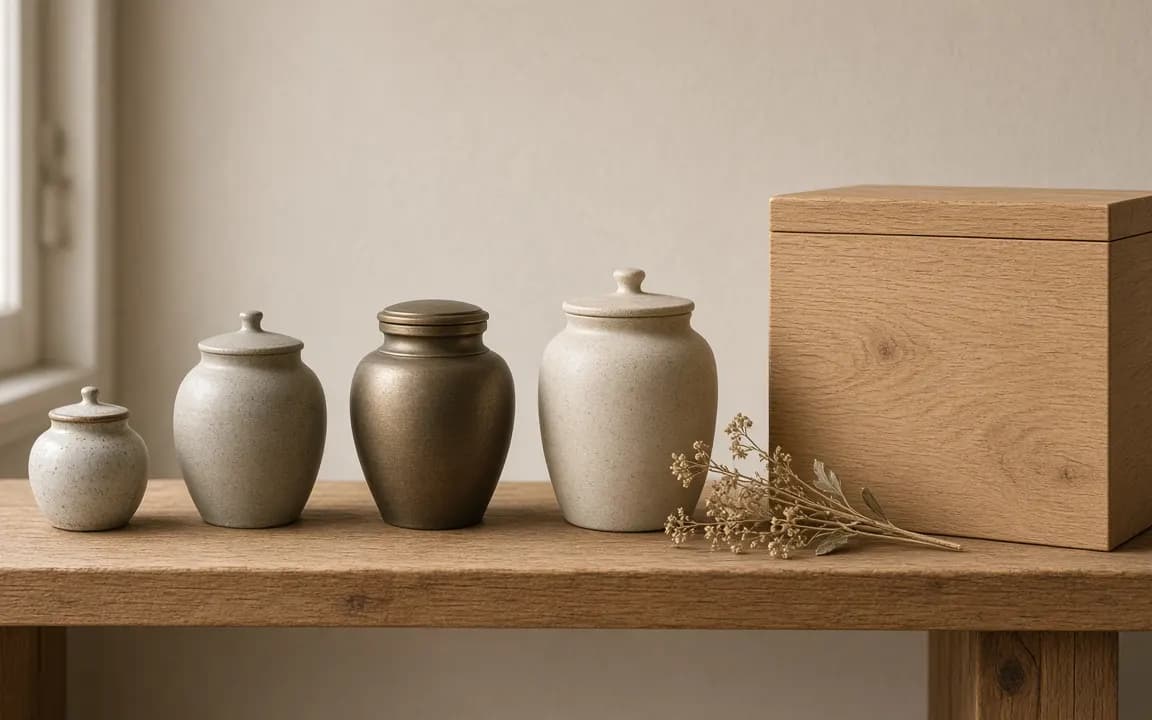
Urn size calculator
Enter your pet's healthy adult weight. We size the urn using the industry rule of 1 cubic inch per pound, plus 10% room to spare.
Recommended urn size
1,210 cu in (19,828 mL)
Look for: Large-animal urn, chest or several urns
| Total ashes (by volume) | 1,100 cu in (18,026 mL) |
|---|---|
| Expected ash weight | 33 lb–55 lb |
| Urn with 10% margin | 1,210 cu in (19,828 mL) |
Standard sizes: small up to 20, medium up to 60, large up to 120 and extra large 200+ cubic inches. If you're between sizes, choose the larger one.
Source: Embrace Pet Insurance - Bury or Cremate Your Dog? Costs, Pros & Cons; Our estimate. 1 cu in per lb is an industry rule of thumb
Next step: Find urns and prices near you →
Using the calculator
Three inputs, and what each one changes
Enter your horse's weight, choose how many people will share the ashes, and say whether you want keepsakes. The calculator shows the total volume to plan for, a suggested urn size for each share, and how much the keepsakes would take. It updates instantly, so you can try a few ways of dividing things.
If your horse is going to a crematory that returns only a portion of the ashes, ask how much, then enter a lower weight to match. The volume scales directly, so half the ashes means half the urn space.
The rule of thumb
How urn volume is calculated for a horse
Urn makers use a simple rule: one cubic inch of space per pound of body weight. It's the same rule that gives a 70 lb dog about 70 cubic inches, as in our small-pet estimate: 12 cu in (cat); 70 cu in (dog)[1]. The calculator applies it to your horse and adds a 10% margin, so the ashes aren't packed to the brim.
Cross-checking by weight gives a similar answer. Cremated remains are usually 3-5% of body weight[2], so a 1,100 lb horse returns about 38.5 lb[3] on our estimate. That's a heavy, dense volume, well beyond what any standard pet urn holds.
| Size | Capacity | What it would hold for a horse |
|---|---|---|
| Small | About 20 cu in | A keepsake share |
| Medium | About 60 cu in | A share for one family member |
| Large | About 120 cu in | A generous personal share |
| Extra large | 200 cu in or more | Part of the main ashes; several may be needed |
| Large-animal urn, chest or several urns | Over 220 cu in | The label a whole horse, or a large share, will get |
An example
Worked example: a 1,100 lb Thoroughbred shared three ways
A retired 1,100 lb Thoroughbred gives 1,100 cubic inches by the rule, or about 1,210 with the 10% margin. That's roughly 19.8 liters, a little more than a 5-gallon feed bucket holds. Split three ways between the owner, her daughter and the horse's longtime lease rider, each share is about 367 cubic inches. With the margin, the tool suggests about 403 cubic inches (6,609 mL) for each person and labels it a large-animal urn, chest or several urns.
Even a third is two extra-large urns' worth. In practice, the family might keep one extra-large urn at home, give the lease rider a large keepsake urn, and scatter the rest over the field where the horse retired. Our article on urn sizing and selection for horses shows containers that suit that kind of plan.
Choosing containers
What to do with a volume this large
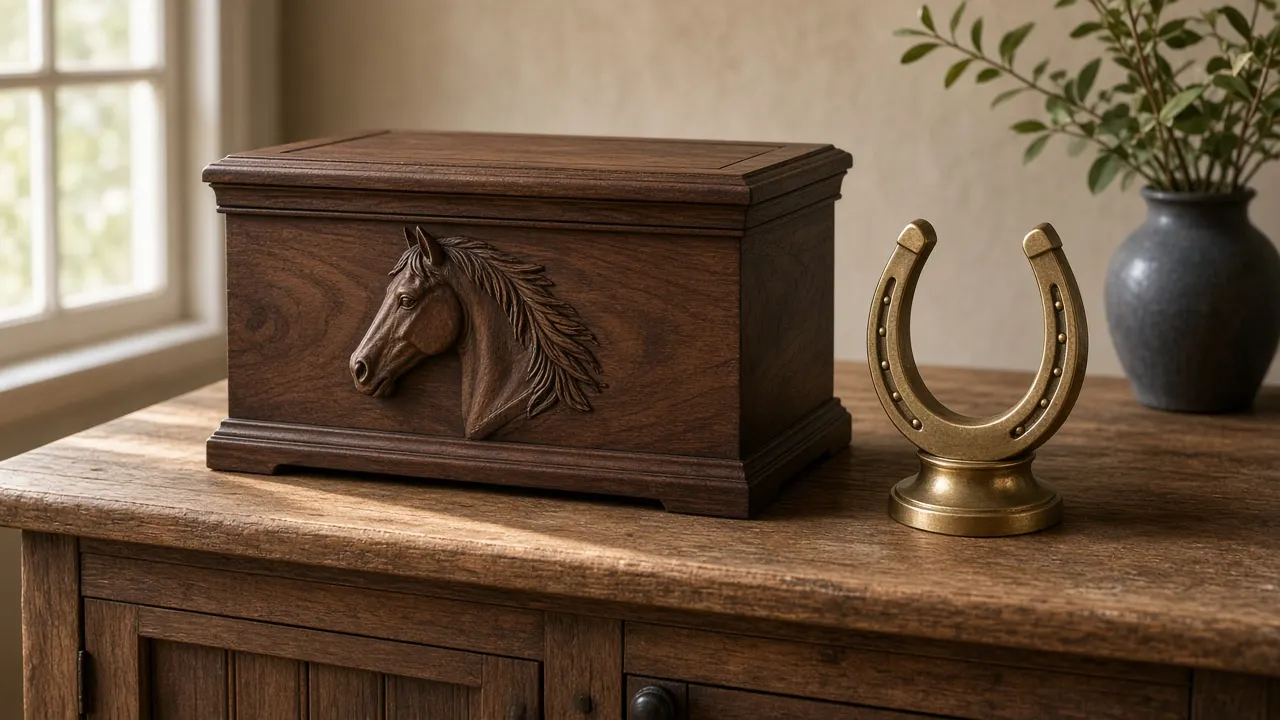
Few people want a 20-liter urn on a shelf. Common approaches for horses are a wooden memorial chest, several matching urns, a scattering tube for most of the ashes plus one keepsake, or burial of the bulk under a tree with a small urn kept indoors. One industry report puts personalized pet urns at about USD 50–1,000+[4], and very large ones sit at the top of that range.
Ask the crematory what container the ashes come back in, and whether their operators hold a CANA pet crematory certification. For horses, it's often a sturdy box or bag that you can keep while you decide. There's no rush to buy an urn in the first week. The ashes sharing planner helps once you know who wants a share.
Free tool
Ashes sharing planner
Split ashes fairly between family members, keepsake urns and jewelry.
If your horse's ashes came home, what would you do with them?
Tap an answer to vote and see how others answered. Anonymous.
Being honest
Where the urn calculator can be off
- Bone, not weight, drives ash volume. A peer-reviewed study of 100 cremations found frame size was the stronger predictor. A lean, big-boned horse may return more than a well-covered one of the same weight.
- Some providers return a portion. Check before you buy containers.
- Urn capacities vary. Makers measure differently, so check the stated cubic inches, not just the label.
- Processing differs. Finer processing packs more tightly than coarse remains.
If you want a weight-based figure alongside the volume, the ashes weight estimator gives a range in pounds.
There's one more thing the calculator can't size: the keepsakes that aren't ashes at all. A braided tail, a lock of forelock or a last shoe often means more to a rider than a share of the urn, and they take up no urn space. They must be saved before collection, so read our mane and tail memorial planning guide early.
What to do next
Next steps before buying an urn
Confirm with your provider how much of the ashes will come back and in what. Decide who wants a share and whether any will be scattered or buried. Then buy containers to fit. If you haven't chosen a provider yet, our guide to choosing an equine-capable provider covers the questions, or ask us to find one near you.
If you plan to scatter most of the ashes, check with the landowner first and choose a calm, dry day. Horse ashes are coarse and pale and settle quickly on grass. Many owners pick the gateway to a favorite field or the edge of an arena where the horse worked. Our walk-through of what happens during horse cremation explains why the remains look the way they do.

Reader polls
What would you choose?
Vote anonymously and see how other readers answered. The results are live counts from people who visit this site, so they show real opinions, not a scientific sample.
If your horse's ashes came home, what would you do with them?
Tap an answer to vote and see how others answered. Anonymous.
What would you most want to keep from your horse?
Tap an answer to vote and see how others answered. Anonymous.
Where are (or will be) your pet's ashes?
Tap an answer to vote and see how others answered. Anonymous.

Free tools to help you plan
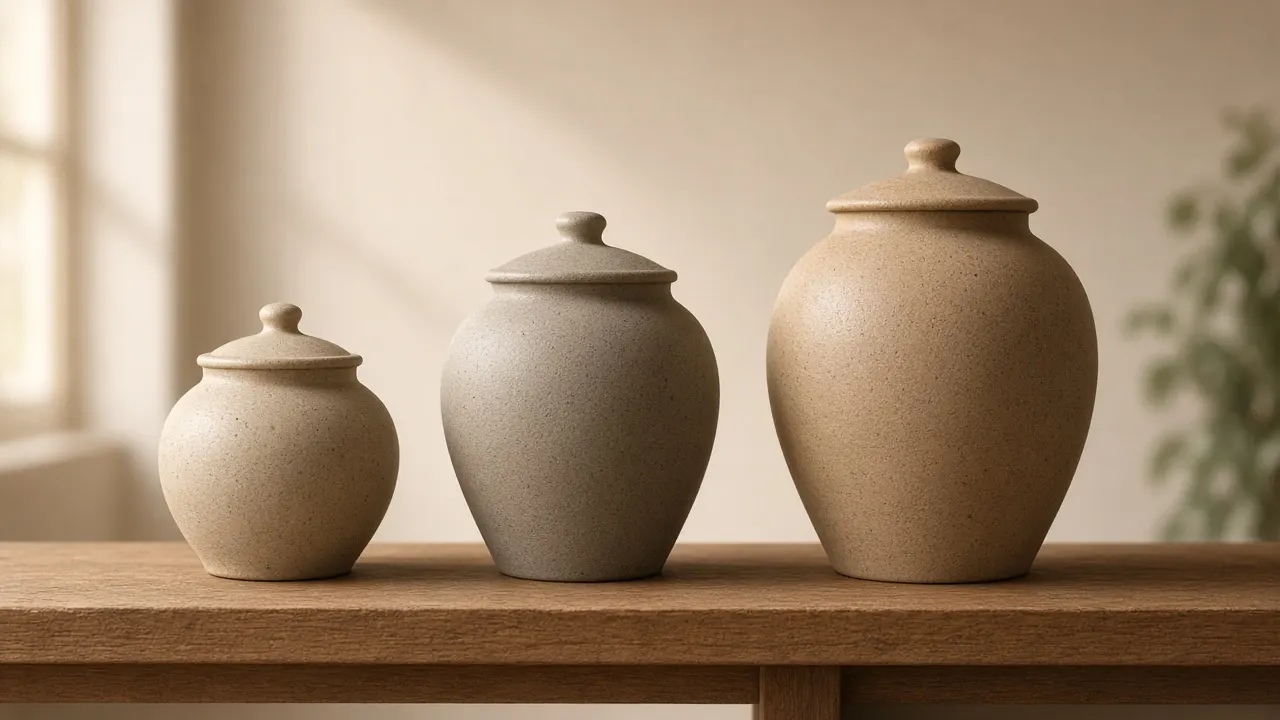
Urn size calculator
Find the urn volume you need from your pet's weight, plus keepsake and sharing options.
Ashes sharing planner
Split ashes fairly between family members, keepsake urns and jewelry.

Ashes weight estimator
See roughly how much ash to expect back, by species and body weight.
Questions people ask
Can I fit a whole horse's ashes in one urn?
Only a very large one. A 1,100 lb horse needs roughly 1,100 to 1,200 cubic inches, which is several extra-large pet urns. Some owners use a wooden chest or a custom container; many keep a smaller share and scatter or bury the rest.
How many keepsake urns can one horse fill?
A lot. The calculator allows about 3 cubic inches per keepsake urn, so a full-size horse's ashes could fill hundreds, and even small 20 cubic inch urns would take dozens. In practice, most families choose a handful of keepsakes for the people closest to the horse and keep or scatter the remainder.
What urn size do I need for a pony or miniature horse?
Use the same rule of one cubic inch per pound. A 250 lb miniature horse needs roughly 250 to 275 cubic inches, which one or two extra-large urns can hold. A 600 lb pony needs about 600 to 660 cubic inches.
Should I buy the urn before the cremation?
There's no need. Crematories return the ashes in a temporary container, so you can take time to decide how to divide them. Buying after you know the returned amount avoids paying for an urn that's too small or far too large.


Sources and our estimates
- [1] Using the industry rule of thumb of 1 cubic inch of urn space per pound of body weight, a 12 lb cat needs an urn of about 12 cubic inches; a 70 lb dog needs about 70 cubic inches. Our estimate: urn cu in = body weight lb x 1 (industry rule of thumb, not a measured value). How we calculate.
- [2] Embrace notes cremated remains typically weigh about 3-5% of the pet's original body weight. Embrace Pet Insurance - Bury or Cremate Your Dog? Costs, Pros & Cons, 2025.
- [3] A 1,100 lb horse would be expected to return roughly 38.5 lb of cremated remains (plausible range 33-55 lb). Our estimate: 1,100 lb x 3.5% (range 3%-5%). How we calculate.
- [4] Personalized pet urns range from about USD 50 to more than USD 1,000. Astute Analytica via GlobeNewswire — Global Pet Preservation Services Market to Hit USD 112.7 Million by 2032 (Apr 2, 2024), 2024.
Get urn and cremation options for your horse
Tell us what you need and where you are. We'll reply by email with clear options and prices so you can decide in your own time.