Can you bury a horse on your own land?
In most US states, yes, if you follow rules on depth, soil cover and distance from wells, water and property lines. Those rules vary by state and county, so check locally before digging; where burial isn't practical, cremation lets you keep your horse's ashes at home instead.
By the Equine Cremation Services editorial team · Updated September 24, 2026 · 4 min read · Sources
- Depth and setback rules in plain terms
- What burial actually costs
- When burial isn't allowed or sensible
The short answer
Is it legal to bury a horse on your property?
In most US states, yes. Burial of livestock and horses on the owner's land is generally allowed as long as the grave is deep enough, well covered, and far enough from wells, streams, sinkholes and property lines. Some counties and towns add their own restrictions, and a few areas with high water tables or sensitive aquifers discourage or restrict it.
Penn State Extension's summary of Pennsylvania's rules, for example, lists burial as one of 4 legal methods[1] for dead stock, alongside rendering, composting and incineration, and notes that open burning isn't one of them. Call your state department of agriculture, county extension office or local health department before you dig. It's usually a quick answer.
Depth and distance
How deep and how far from water must a horse be buried?
National extension guidance on horse disposal suggests a trench about 9 ft deep[2] and roughly 7 feet wide, covered with 3 to 4 feet of soil, and well away from wells and streams. State minimums differ. Here are a few examples to show the range.
| Place | Key requirements |
|---|---|
| Pennsylvania | At least 2 ft of soil cover, 2 ft above bedrock and seasonal high water; 100 ft from wells, sinkholes, waters and property lines (200 ft recommended) |
| Minnesota | 5 ft above high water level, 3 ft of soil cover, soils more than 10 ft from bedrock |
| Michigan | Within 24 hours, at least 2 ft deep, 200 ft from wells, density limits per acre |
| California | Routine livestock burial on the owner's land allowed, subject to regional water board rules |
| England | Horses may be buried; at least 50 m from any well, borehole or spring |
Sources: Pennsylvania's 100 ft setback[3] rule, Minnesota's 3 ft cover[4] requirement, Michigan's burial rules[5], California's livestock provisions[6] and England's 50 m well setback in the Environment Agency's animal burial guidance[7], which works out to about 164 ft[8] on our conversion. These change, so always confirm the current rule where you live.
The budget
How much does it cost to bury a horse?
Most of the cost is the machinery. Renting a backhoe has been reported at $250-$500[9]. If you own a tractor with a backhoe attachment, or a neighbor or contractor has an excavator, it can cost less, though you may pay for the operator's time. Add a marker or headstone if you'd like one.
A pet cemetery is another route for owners who want a grave but can't use their own land. One Colorado cemetery lists large-animal burial, including horses, at $3,000[10], with plot, marker and care included. Our cost guide compares burial with cremation line by line, and the horse aftercare cost comparison does it for your horse's weight.

Free tool
Horse aftercare cost comparison
Compare equine cremation, burial, rendering and composting side by side.
On your land
How do you choose a burial spot for a horse?
- Away from water. Wells, springs, streams, ponds and field drains all need a wide margin, and downhill of a well is worse than uphill.
- Dry, deep soil. Avoid low spots that flood, shallow bedrock and sandy soils over aquifers.
- Reachable by machinery, and ideally near where your horse will die or be euthanized, so moving the body is short.
- Somewhere you'll keep. If you might sell the farm, think about how you'd feel leaving the grave behind.
- Call 811 first. In the US, the free utility-locating service marks buried lines before you dig.
If the euthanasia is planned, you can have the grave dug in advance, close to where your horse will stand. Talk to your vet about the arrangement; our farm access guide covers the practical side of positioning.
Sometimes it doesn't work
When is burying a horse not a good idea?
Frozen ground can make burial impossible for months in northern states. A high water table, rocky soil or a small property may make it impossible to meet setbacks. Some owners simply don't want to leave their horse behind if they move. And if your horse had certain infectious diseases, your vet or state may require a different method.
Euthanasia also plays a part. The injected drug remains in the body, and since 2003[11] US labels have warned that euthanized animals must be buried deeply or otherwise disposed of so scavengers can't reach them. That's one reason good cover depth matters. Our article on working with your vet covers this.
If you had to decide today, what would you choose for your horse?
Tap an answer to vote and see how others answered. Anonymous.
Keeping them home another way
What if you can't bury your horse but want them to stay home?
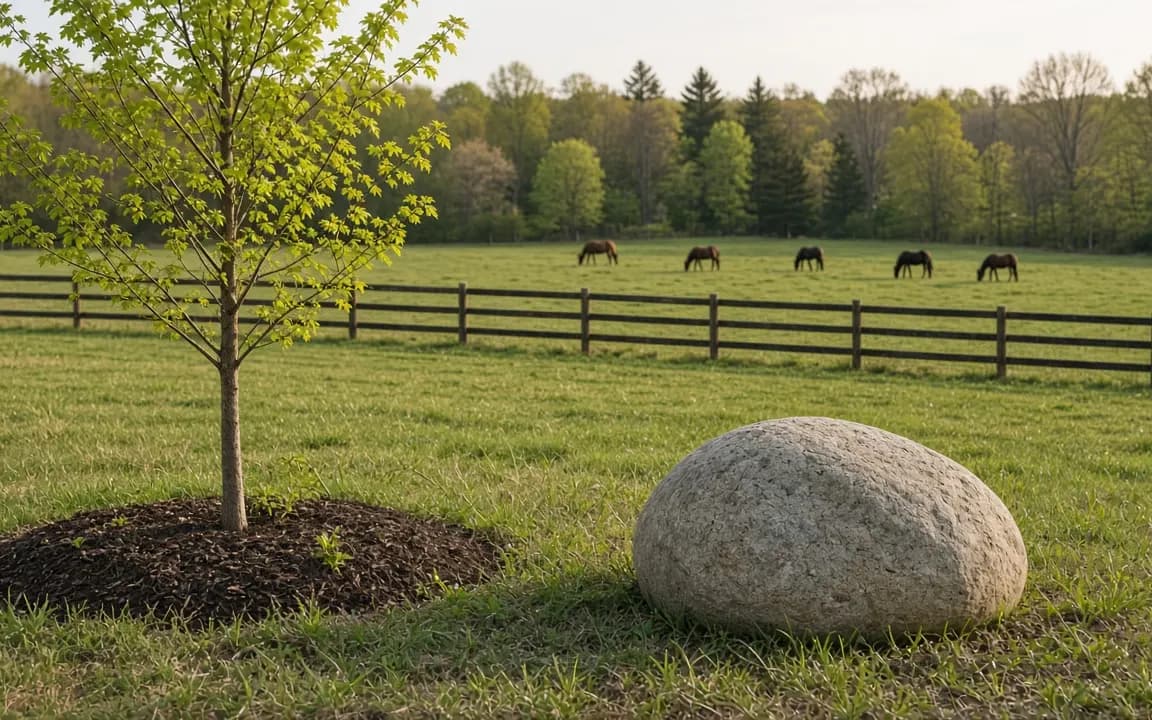
Cremation is the usual answer. You can bury or scatter the ashes on your land with far fewer restrictions than a whole-body burial, plant a tree over them, or keep them in an urn that moves with you. A 1,100 lb horse returns around 38.5 lb[12] of ashes on our estimate, enough for a small burial and keepsakes.
Our services page sets out cremation alongside rendering and composting, and the urn sizing article covers containers for ashes you'd like to bury. If you'd like local cremation prices to compare with burial, send us your horse's details.
Keeping a horse home doesn't have to mean a grave. It can mean a tree, a field, or a box on the mantel that goes wherever you do.

Reader polls
What would you choose?
Vote anonymously and see how other readers answered. The results are live counts from people who visit this site, so they show real opinions, not a scientific sample.
If you had to decide today, what would you choose for your horse?
Tap an answer to vote and see how others answered. Anonymous.
Where would you want your horse's last moments to be?
Tap an answer to vote and see how others answered. Anonymous.
If you had to decide today, which aftercare would you choose for your pet?
Tap an answer to vote and see how others answered. Anonymous.


Questions people ask
Do I need a permit to bury a horse?
Usually not for a single horse on your own land, but it depends on your state and county. Most places set rules on depth, cover and distance from water rather than requiring a permit. Check with your state agriculture department or county extension office before digging, as some localities do require approval.
How big a hole do you need to bury a horse?
Extension guidance suggests roughly 7 feet wide and about 9 feet deep, so there's 3 to 4 feet of soil over the body, though state minimums vary. The length needs to fit your horse lying on its side, often 8 feet or more. A backhoe or excavator is essential.
Can I bury my horse in winter?
Only if you can dig through the frozen layer, which may need heavy equipment or be impossible in deep frost. Some owners store the body with a provider, or choose cremation or rendering instead. If you're in a cold state and your horse is old, include a winter plan in your aftercare arrangements.
Can I bury a horse that was euthanized?
Yes, in most places, but the drug remains in the body, so deep burial and good soil cover are essential to keep scavenging animals away. Cover the body securely until the grave is ready, and keep dogs indoors. Follow your state's depth and setback rules carefully.
Is it better to bury or cremate a horse?
Neither is better in general. Burial keeps your horse on your land at a lower cost if rules and ground allow. Cremation costs more but lets you keep, scatter or move the ashes, which suits boarders, renters and anyone who might sell. Many owners choose based on whether they'll stay on the property.


Sources and our estimates
- [1] Pennsylvania Extension notes that open-air burning is not a legal way to dispose of dead stock; legal options are composting, rendering, incineration and burial. Penn State Extension - Livestock and Poultry Mortality Disposal in Pennsylvania (J. Craig Williams, updated Oct 2025), 2025.
- [2] Extension guidance recommends a horse burial trench about 7 feet wide and 9 feet deep, covered by 3-4 feet of soil, and no fewer than 100 yards from wells and streams. Extension Horses (eXtension national Cooperative Extension) - Horse Disposal Options, 2019, 2019.
- [3] Pennsylvania on-farm burial requires at least 2 feet of soil cover, 2 feet of clearance above bedrock and the seasonal high water table, and at least 100 feet from wells, sinkholes, waters and property lines (200 feet recommended). Penn State Extension - Livestock and Poultry Mortality Disposal in Pennsylvania (J. Craig Williams, updated Oct 2025), 2025.
- [4] Minnesota Board of Animal Health rules require buried horses to be 5 feet above the high water level, covered with 3 feet of soil, and in soils more than 10 feet from bedrock. University of Minnesota Extension - Horse carcass disposal (Martinson & Wilson, reviewed 2022), 2022.
- [5] Michigan requires dead animals to be buried within 24 hours, at least 2 feet deep and not within 200 feet of a well, with no more than 100 burial sites or 10,000 lb of animals per acre. Michigan Farm News (Michigan Farm Bureau) - MDARD reminder: Animal burial options, 2024.
- [6] California prohibits composting of unprocessed mammalian tissue such as cattle, goats and sheep (14 CCR 17855.2); owners may bury routine livestock mortality on their property within 3 miles of where the animal died, subject to regional water board rules. UC Cooperative Extension (Schohr, Lile, Snell) - Livestock Carcass Management, UC ANR 2021, 2021.
- [7] In England, a buried horse or other large pet must be at least 50 m from any well, borehole or spring; most other animal burials need 250 m from drinking-water sources, 30 m from watercourses and 10 m from field drains. GOV.UK (Environment Agency) - Animal burials: prevent groundwater pollution, 2024.
- [8] England's 50 m well setback for burying a horse equals about 164 feet, 1.6 times Pennsylvania's 100-foot minimum setback from wells. Our estimate: 50 m x 3.2808 ft/m; 164 / 100. How we calculate.
- [9] Renting a backhoe to bury a horse costs roughly $250-$500, and horse disposal in a landfill (where accepted) costs about $80-$150. Extension Horses (eXtension national Cooperative Extension) - Horse Disposal Options, 2019, 2019.
- [10] Precious Memories Pet Cemetery (Colorado/Wyoming) charges $1,500 for a small-animal burial including plot, standard granite marker, opening/closing and extended care, and $3,000 for large animals such as horses. Precious Memories Pet Cemetery – Burials, 2026.
- [11] Since 2003 the FDA has required euthanasia drug labels to warn that euthanized animals must be disposed of by deep burial, incineration or another approved method to keep scavenging wildlife from eating the carcass. Cornell Waste Management Institute & Penn State - Horse Mortality: Carcass Disposal Alternatives (2012), 2003.
- [12] A 1,100 lb horse would be expected to return roughly 38.5 lb of cremated remains (plausible range 33-55 lb). Our estimate: 1,100 lb x 3.5% (range 3%-5%). How we calculate.
Compare burial and cremation for your horse
Tell us what you need and where you are. We'll reply by email with clear options and prices so you can decide in your own time.